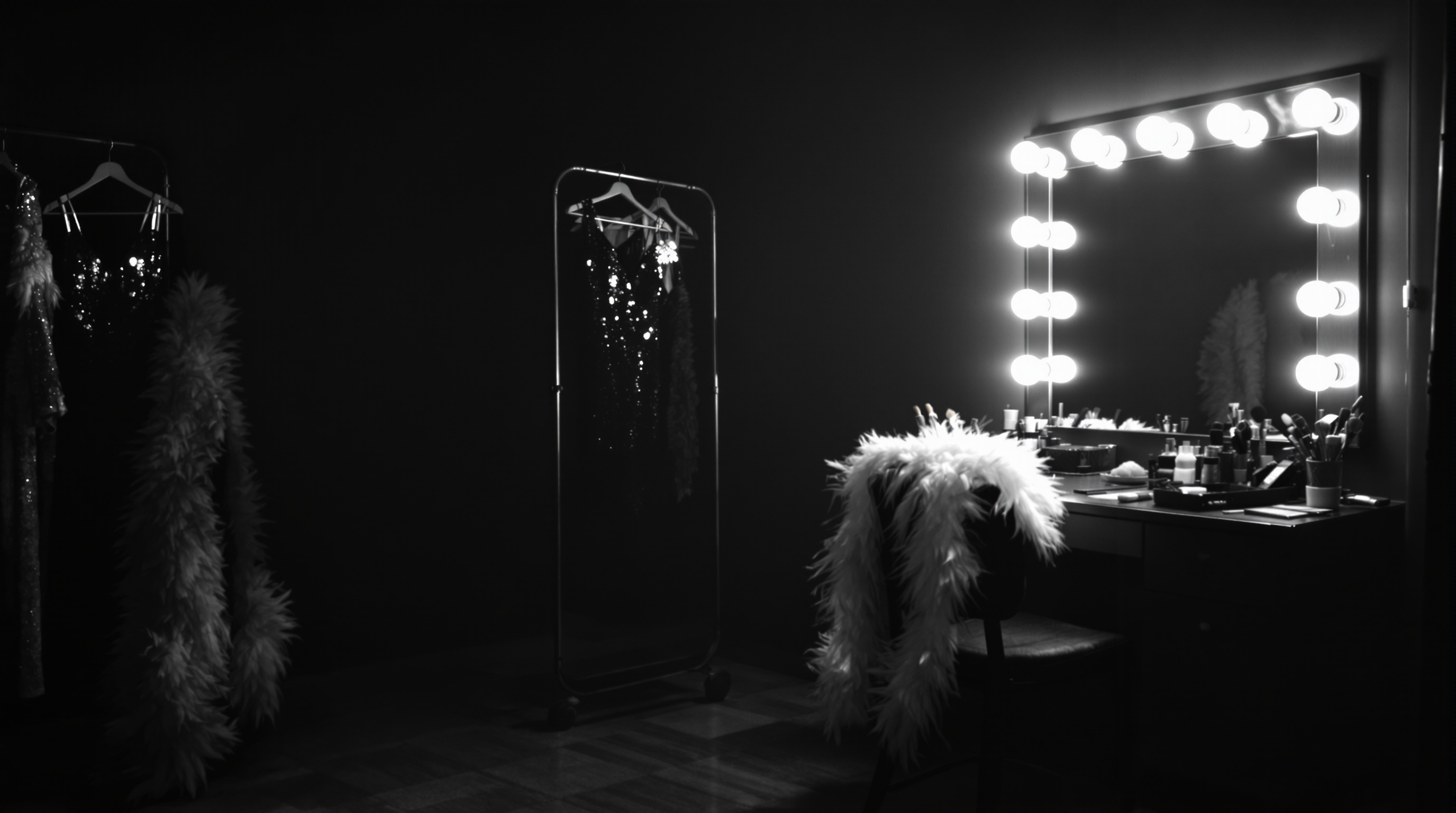
Backstage: Photographing Performance Communities
Every performance community lives in two rooms: the one the audience sees and the one where the transformation happens. The backstage documentary — photography made in dressing rooms, wing spaces, and the long hours before curtain — is one of the medium's oldest fascinations, because it photographs the exact seam between a person and a persona.
A Tradition of the Threshold
Photographers have been drawn to performers' private spaces since the medium could operate by lamplight. The tradition runs from the Parisian cabaret photographers of the 1930s through the circus, vaudeville, and burlesque documentarians of mid-century, to the drag houses, club troupes, and community theaters photographed across the 1980s and 1990s. One such body of work concerned a performance troupe photographed over years in a regional scene; this essay treats the genre rather than any photographer's images.
What unites the tradition is its subject: not performance, but preparation. The half-made face in the mirror, the costume on its rack, the company sharing cigarettes and nerves at the stage door. Audiences see finished illusion; the backstage photograph sees labor — and the strongest work in the genre is finally about work, in the same way the great industrial documentaries are.
Access Is the Whole Game
A dressing room is among the most defended spaces a photographer can ask to enter. Performance communities — especially those, like drag houses, that have historically faced hostility — protect their backstage fiercely, and access is granted to people, not portfolios. The working method echoes every long-term documentary form covered on this site: show up without the camera first, keep showing up, photograph only when presence precedes permission. Many of the genre's landmark projects began with a photographer who was already part of the community's extended family — a friend, a fan, a regular — before a single frame was made.
- Respect the mask. Performers control their image professionally; the photographer's privilege of seeing them unmasked carries an explicit duty of consultation about what gets shown.
- Stage names are names. Captioning and exhibition should follow each performer's wishes about which identity appears in print — for some communities this is a safety matter, not a stylistic one.
- Photograph the company, not just the stars. Troupes are ensembles, economically and emotionally; the documentary that follows only its most photogenic member misrepresents the institution.
Why These Archives Matter
Performance scenes are perishable. Venues close, troupes dissolve, scenes scatter — and very often the photographs are the only institutional record a community leaves. Archives now actively collect this material: the Billy Rose Theatre Division of the New York Public Library holds millions of items documenting performance communities at every scale, and the Smithsonian's LGBTQ history collections preserve exactly the kind of club and troupe documentation that once seemed too marginal to keep. A photographer documenting a performance community today is, whether they intend it or not, building a future archive — and should label, date, and store the work accordingly.
For the low-light craft this genre demands, see The Fine Print and Available Light. For the community-scale documentary impulse in non-theatrical settings, see Community and Place.
The Long Run of a Troupe
Performance communities reward the same patience as families. A troupe photographed across years yields a narrative no single season can: debuts and farewells, the house style evolving, costumes recut for new bodies, the dressing-room wall accumulating its archaeology of photographs and notes. The photographer who stays also witnesses the institution's economics — the fundraisers, the van repairs, the second jobs — which is where the genre's real story usually lives. As with the domestic document, the work gets better as the camera gets duller: by year three, nobody performs for it, and the photographs finally show the company as it knows itself.