Community and Place: Photographing Where You Live
The documentary tradition's most romantic figure is the photographer who travels far; its most productive figure is the one who stays home. The community document — years of sustained photography within one town, one county, one scene — is how most of the medium's truly irreplaceable archives were made.
The Case for Staying
A visiting photographer makes pictures of how a place looks; a resident photographer makes pictures of how it works. Access that takes outsiders months — kitchens, fire halls, hunting camps, church basements, the back rooms of small businesses — is the local's birthright. And the local's archive compounds: photograph a county fair for one summer and you have coverage; photograph it for twenty and you have a longitudinal record of an economy, a demography, and a culture. The great regional projects of American photography were almost all made by people photographing their own ground, from the Depression-era county surveys to the small-town studies of the 1970s and 1980s documented in the Farm Security Administration archive and its successors.
The Porch, the Counter, the Hall
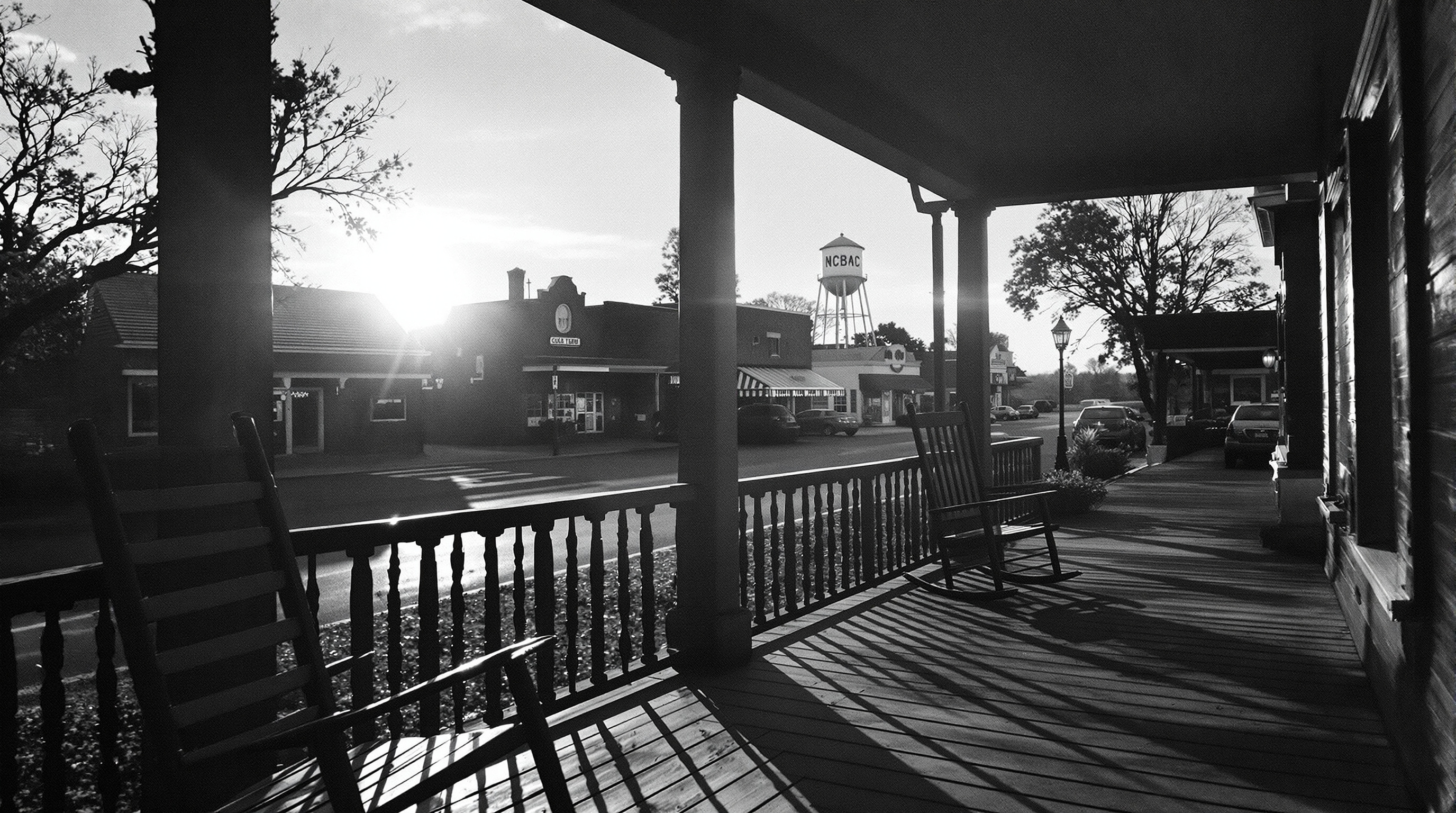
Community photography has recurring stages — the architecture where a town's private and public lives meet. The porch is the classic American example: half-domestic, half-street, it is where people present themselves to their neighbors, and porch portraiture is practically its own genre in the rural documentary tradition. The store counter, the diner booth, the bar rail, the church step, the bleachers — each is a setting where photography is socially natural, where people expect to be seen and can be met as themselves. A photographer mapping a community project does well to inventory these stages first; the work tends to organize itself around them.
Method for the Long Local Project
- Cover the calendar. A town's year — planting, graduation, fair, harvest, holidays — is its true structure. Photograph the cycle repeatedly and change becomes visible.
- Follow the institutions. Volunteer fire companies, school teams, congregations, union halls, garden clubs: communities persist through institutions, and institutions love being documented.
- Photograph work. Local economies are visual — the dairy barn, the machine shop, the crab house. Labor is where a place's identity is most concrete.
- Caption like a historian. Names, dates, locations, relationships. Fifty years on, the captions will matter as much as the frames.
Where Community Archives Go
Local documentary work has institutional demand waiting for it. State archives, county historical societies, and university special collections actively acquire regional photographic archives; the National Archives still picture holdings and state-level equivalents are built substantially from such acquisitions, and programs like the Library of Congress's local legacies efforts have repeatedly demonstrated the appetite for town-scale records. A photographer twenty years into a community project is holding a public asset, and should plan its eventual deposit — with labeled negatives and releases in order — as deliberately as the photography itself.
The community document shares craft DNA with everything on this site: its interiors are made by available light, its families become domestic documents, and its individuals, photographed across decades, become long-term portraits.
The Insider's Dilemma
Photographing one's own community carries a tension the visiting photographer never faces: the photographer must keep living among their subjects after the pictures go public. A frame that reads as honest observation in a gallery may read as betrayal at the diner counter. The tradition's working answer is disclosure before exhibition — subjects see their pictures first, locally, before strangers do — and a public edit weighted toward respect without tipping into boosterism. Communities forgive unflattering truth far more readily than they forgive surprise. The photographers who have sustained decades-long local projects are invariably the ones their towns still speak to, which is itself the credential the work runs on.