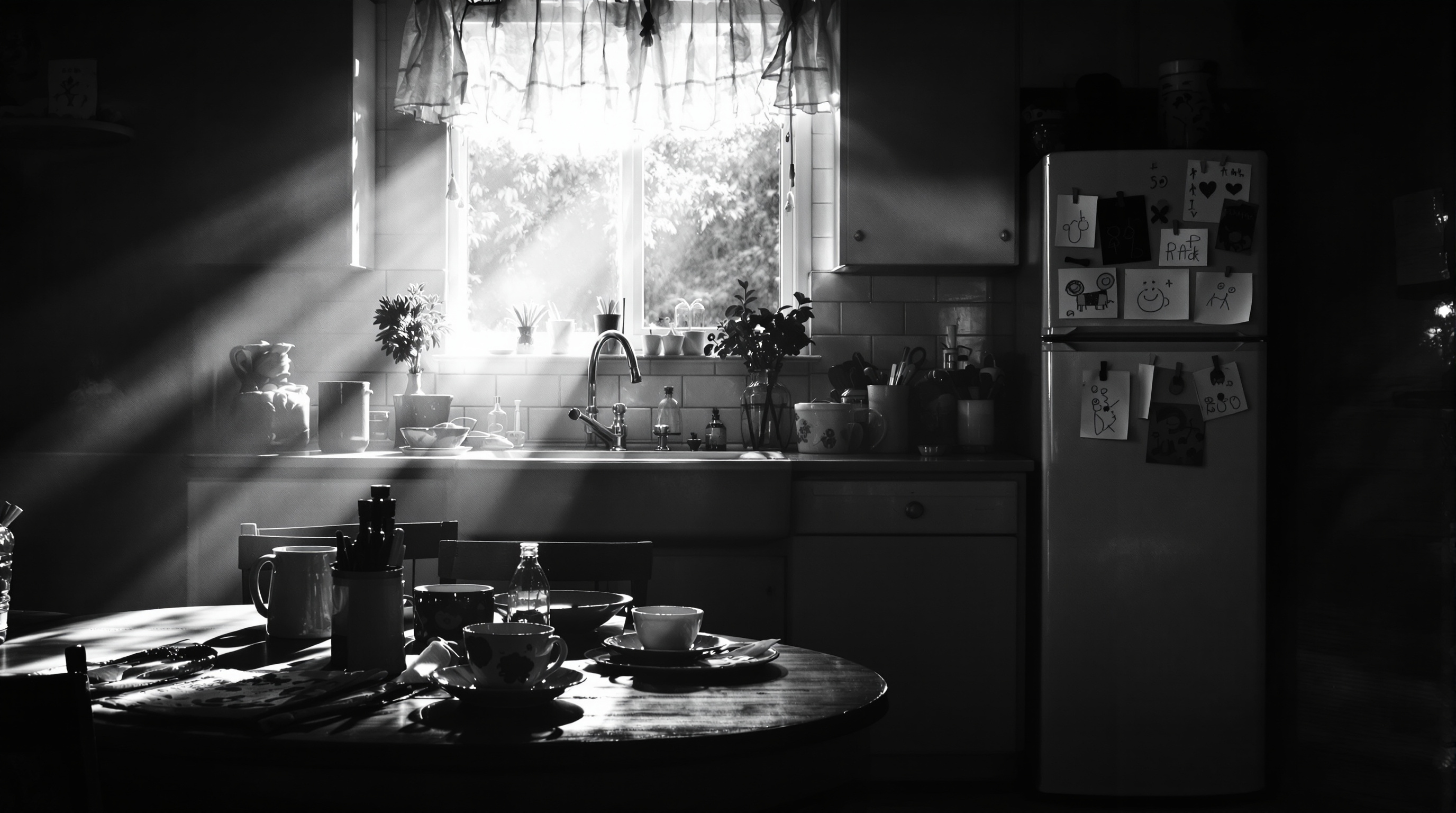
Family as Subject: The Domestic Documentary Tradition
The most photographed environment on earth is the home, and yet the honest family document remains one of photography's rarest achievements. Snapshots flatter; the domestic documentary observes. This essay traces the tradition of photographers who turned sustained, serious attention on a household — sometimes their own, sometimes a family that let them in — and kept returning for years.
From Album to Document
Every family keeps an album, but albums are curated toward occasions: birthdays, graduations, the beach. The domestic documentary inverts the album's logic. Its material is the unphotographed middle of life — dishes, doorways, arguments cooling, children bored on couches, the bedroom as it actually looks. When photographers began treating this territory as worthy of the same craft applied to war zones and statesmen, the results unsettled people precisely because they were unfamiliar: nobody had seen ordinary domestic time printed with that much care.
The tradition has two main branches. In the first, the photographer documents their own household from inside — the work is autobiographical, and the camera is part of the family. In the second, an outside photographer is granted long-term access to someone else's home, returning across years until the family stops performing. Both branches converge on the same discovery: a family photographed over a decade becomes a story about time, not just people. Rooms change, children lengthen, the same kitchen table hosts a procession of years. Museums now collect this work seriously; the J. Paul Getty Museum's photographs collection and the Museum of Modern Art both hold landmark domestic series.
Method: Disappearing Inside a House
Photographers who have done this work describe a consistent method. Visit often enough to be boring — the camera only sees honestly after it stops being an event. Use small, quiet equipment and the light the house already has (see Available Light for the craft specifics). Photograph the spaces as attentively as the people: the domestic documentary's secret subject is the household itself, and an empty hallway can carry as much narrative as a face. And accept the genre's defining constraint — you cannot direct. The moment a photographer begins arranging a family, the document collapses back into an album.
Ethics at the Kitchen Table
Domestic work entangles the photographer in the family's own politics of disclosure. Spouses may disagree about what is showable; children's consent matures and must be honored retroactively; a frame that one member finds tender another may find humiliating. The working consensus in the field mirrors the rules for any long-term portraiture — continuous consent, subject veto power, and a public edit that errs toward dignity — with one addition specific to families: the photographer must consider the family's future readers. Children in documentary photographs grow up to be adults with colleagues and searchable names. A genuinely ethical domestic project is edited with the subjects' forty-year-old selves in mind.
For the wider household — grandparents, cousins, in-laws, the whole web of kinship — see The Extended Family Album. For projects centered on a single child across decades, see The Long-Term Portrait.
What the Genre Gives Back
It is worth naming what sustained domestic work returns to the families themselves. Households that have been seriously documented over a decade hold a record no snapshot archive approaches: the ordinary days, which is to say the actual life. Family members consistently report that the photographs grow in value as the rooms change and the children leave — that the document of the boring middle becomes, with time, the most treasured object in the house. The genre's gift runs in both directions: the photographer gets the work, and the family gets the years back. This reciprocity, more than any aesthetic theory, explains why families keep letting photographers stay — and why the tradition keeps renewing itself, generation after generation, kitchen after kitchen.