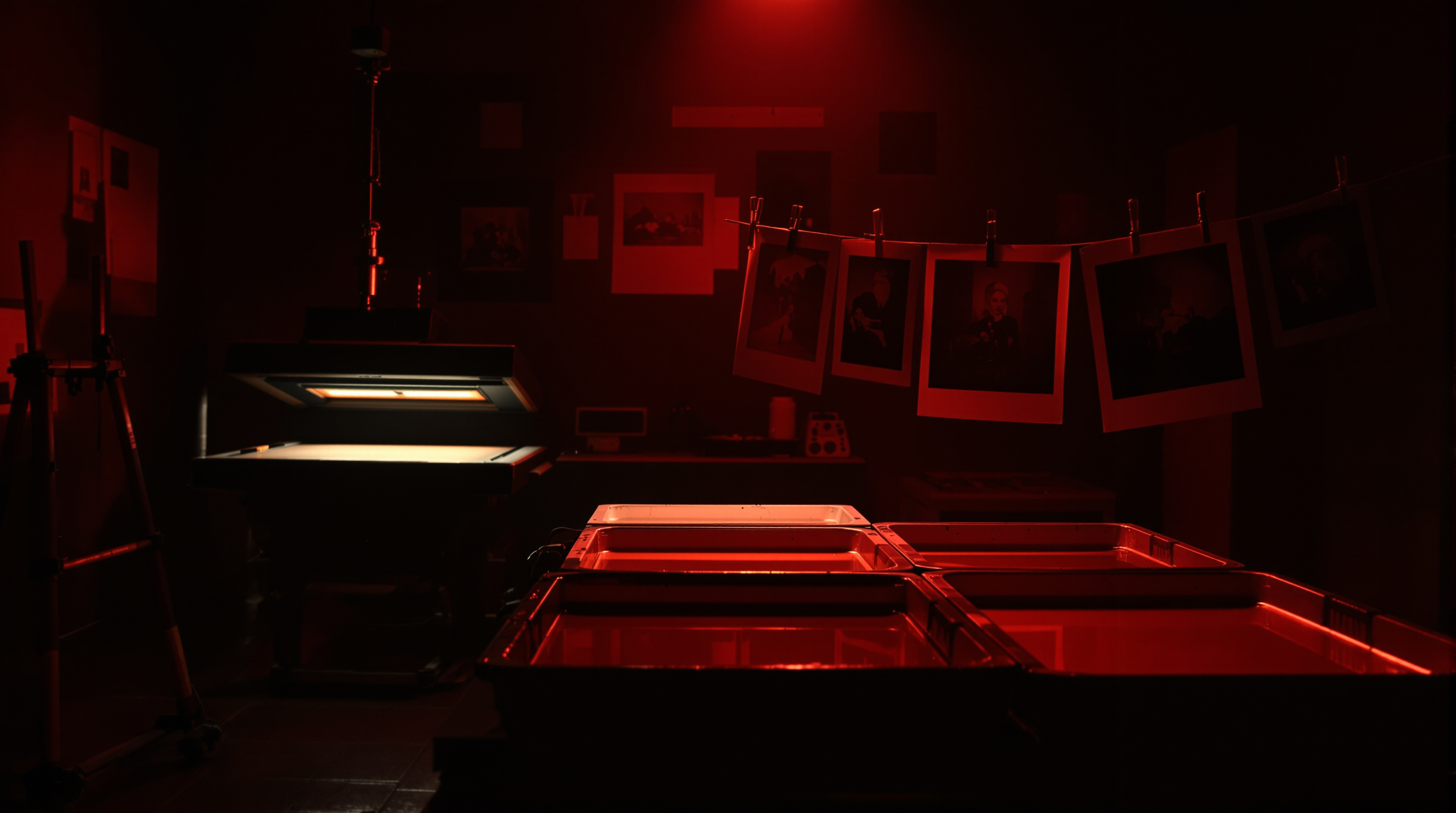
The Fine Print: Black-and-White Film and Darkroom Craft
The classic documentary portrait was not captured; it was built. Built in the choice of film, in the development time, and above all in the darkroom, where a negative's information became a print's interpretation. Understanding that craft — even for photographers who will never smell fixer — explains why the great black-and-white documents look the way they do.
The Negative: Capture as Commitment
Film forced decisions a digital sensor defers. Speed was chosen before the day began: a slow, fine-grained film for light and detail, or a fast film — pushed further in development — for dim interiors, with grain accepted as the price of presence. Documentary portraitists overwhelmingly chose presence. The visible grain of fast black-and-white film became the genre's texture, so identified with honest observation that digital photographers now simulate it.
Black-and-white itself was both an economy and an aesthetic. Monochrome strips a scene to geometry, gesture, and tone — viewers read a black-and-white photograph as form first and inventory second. For portraiture, this is an enormous gift: nothing in the frame competes with the face.
The Darkroom: Printing as Interpretation
A negative, the saying goes, is the score; the print is the performance. The same frame can be printed soft and gray as fog or carved into deep blacks and blazing highlights, and every choice between is an act of meaning. The printer's instruments are few and old: paper grade for overall contrast; dodging (withholding light) to open shadows; burning (adding light) to deepen skies and corners; development and toning to set the print's final temperature. Selenium toning, the classic finishing move, cools the blacks, deepens maximum density, and — not incidentally — helps archival permanence.
What the darkroom taught, more than any technique, was deliberateness. A fine print took an evening. Photographers printed only what deserved the labor, and that economic filter did half the editing. The institutions that conserve this legacy take the craft seriously as an object of study — the George Eastman Museum maintains working process collections and teaches historical printing, and the Library of Congress documents the care of gelatin-silver materials — because a fine print is not a reproduction of an image but an original object, as specific as a painting.
What Transfers to Digital
- Expose for the shadows, develop for the highlights — the Zone System's core trade survives intact as exposing to protect highlight data and processing for tonal placement.
- Print small editions of finished interpretations rather than exporting endless variants; the discipline of the 'final print' is a discipline of decision.
- Master one paper. Printers who knew one paper deeply outperformed printers who knew ten casually. The modern equivalent: one calibrated printer-paper pair, learned thoroughly.
- Let grain be grain. Texture admitted honestly reads as material truth; texture applied as decoration reads as costume.
The darkroom's disciplines underwrite every genre discussed on this site — the long-term portrait depended on consistent processing across decades, and the tonal language of the hospice documentary was a printing achievement as much as a photographic one. For the seeing half of the craft — what happens before the negative exists — continue to Available Light.
The Archive Question
Film's last discipline is custodial. A black-and-white negative, processed to archival standards and stored cool and dry, is among the most durable image media ever made — readable by eye, printable by anyone with a light source, and independent of any file format. Long-term documentary photographers who shot film hold archives that will outlive every hard drive they own, provided the sleeves are labeled and the storage is sane. The conservation literature is mature and freely available, and the habit costs minutes per roll: date, place, subject, frame notes. The photographers whose work fills museum collections are, almost without exception, the ones whose negatives could be found.