Available Light: The Art of the Unposed Portrait
The defining technical decision of the documentary portrait tradition was a refusal: no flash, no lights, no direction. Available light — the light already in the room — is less a technique than a philosophy, and it produced the intimate visual language that separates a document from a session.
Why the Light Already There
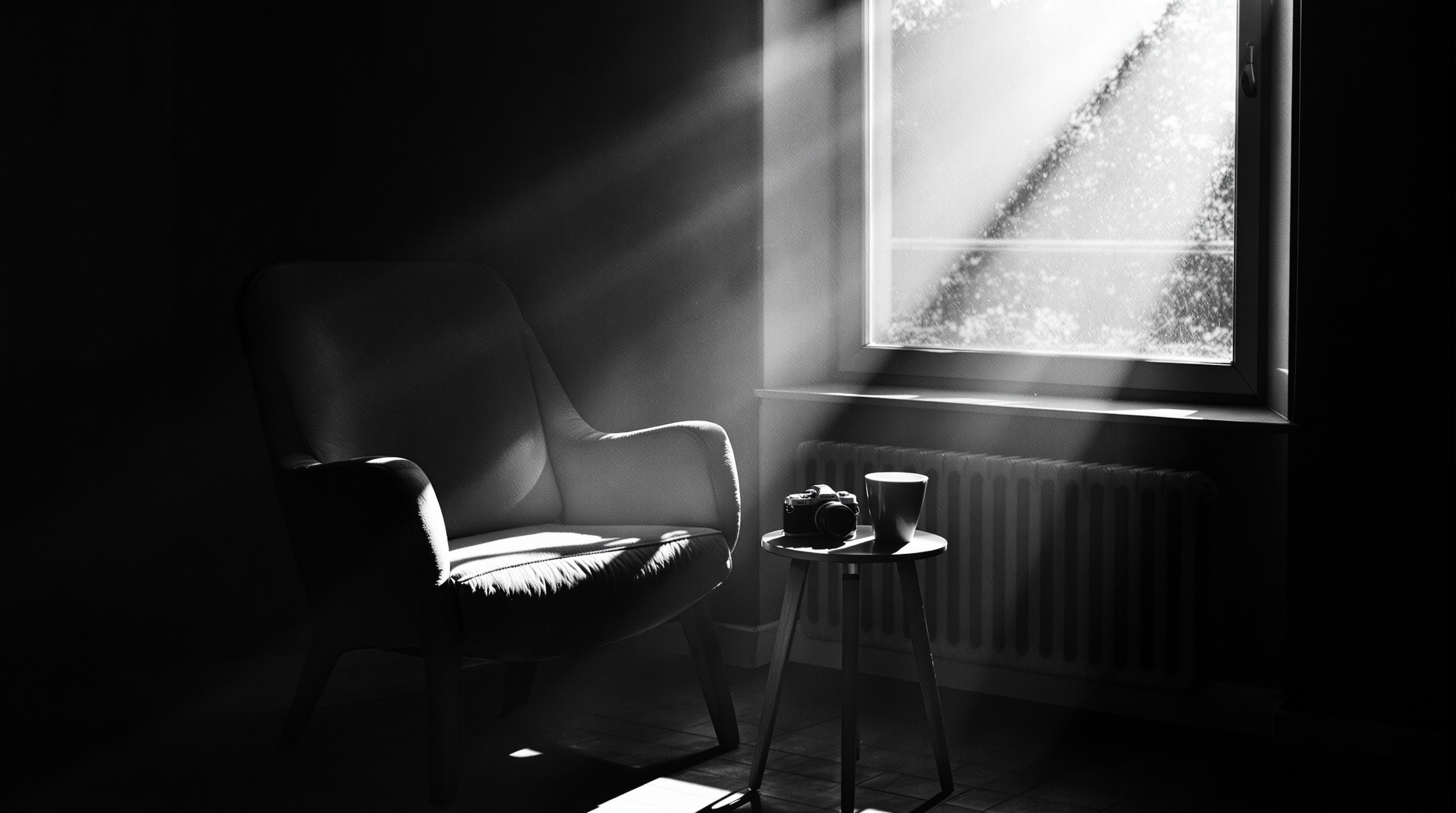
Flash announces the photographer; a tripod-mounted light kit converts a kitchen into a set. The moment a room is lit, its inhabitants begin performing for the apparatus, and the candid contract is broken. Photographers working in homes, hospices, and dressing rooms learned to treat the existing light as part of the truth they were recording — the dim hallway is dim, the lamp-lit bedroom is warm and shadowed, and the photograph that honors this carries the texture of actual life. The viewer can feel the difference even without naming it: available-light photographs look found, lit ones look made.
The Grammar of Window Light
Domestic documentary work runs on window light, and its handling is the genre's core skill. North-facing windows give the soft, directional illumination painters prized for centuries — a fact museum lighting designers still exploit. A subject beside a window sits in light that models the face in one falling gradient; a subject between windows is cross-lit into drama; a subject against the window becomes silhouette and context. The available-light photographer's habit is to read rooms the way a printer reads negatives: where does the light enter, what does it touch, when during the day is it best. Long-term projects in a single house accumulate this knowledge until the photographer knows the building's light by hour and season.
The Kit That Disappears
- Fast lenses, used wide open. The classic documentary aperture is whatever the dimness demands; shallow focus became the genre's look because it was the genre's necessity.
- Fast film, pushed when needed — grain traded for presence, as discussed in The Fine Print.
- Small, quiet cameras. The equipment that intrudes least records most. The tradition's tools were chosen for social, not optical, performance.
- No bag. One body, one or two lenses. The photographer who is rummaging is not seeing.
Anticipation Over Direction
The unposed method replaces control with prediction. Candid photographers describe a learned pre-vision: knowing a beat early that a gesture is coming — the grandmother about to laugh, the child about to bolt — and being framed, focused, and ready when it arrives. This is why the method demands long acquaintance with subjects. Strangers are unpredictable; family, photographed for years, telegraph everything. The patience this requires is the same patience that defines every form covered on this site, from the newborn household to the small-town porch.
Students of the method can study its masters in depth through the International Center of Photography, whose collections and courses center the candid tradition, and through the Museum of Modern Art's photography holdings, where the available-light document — from the street to the kitchen — forms the spine of the twentieth-century collection.
Failure as Method
Available-light work has a high technical failure rate, and the tradition treats this as a feature. Frames lost to subject motion, missed focus, and hopeless dimness are the tax paid for the frames no lit photograph could contain. The working ratio in candid documentary practice has always been brutal — rolls per keeper, not frames per keeper — and accepting it changes behavior: the photographer exposes generously, edits ruthlessly, and never lets a marginal exposure stop an honest attempt. The digital era softened the economics but not the principle. The unposed photograph is a low-percentage shot by definition; the method is to take it anyway, repeatedly, for years.